The one-way valve of electronics — and the foundation of all semiconductor devices
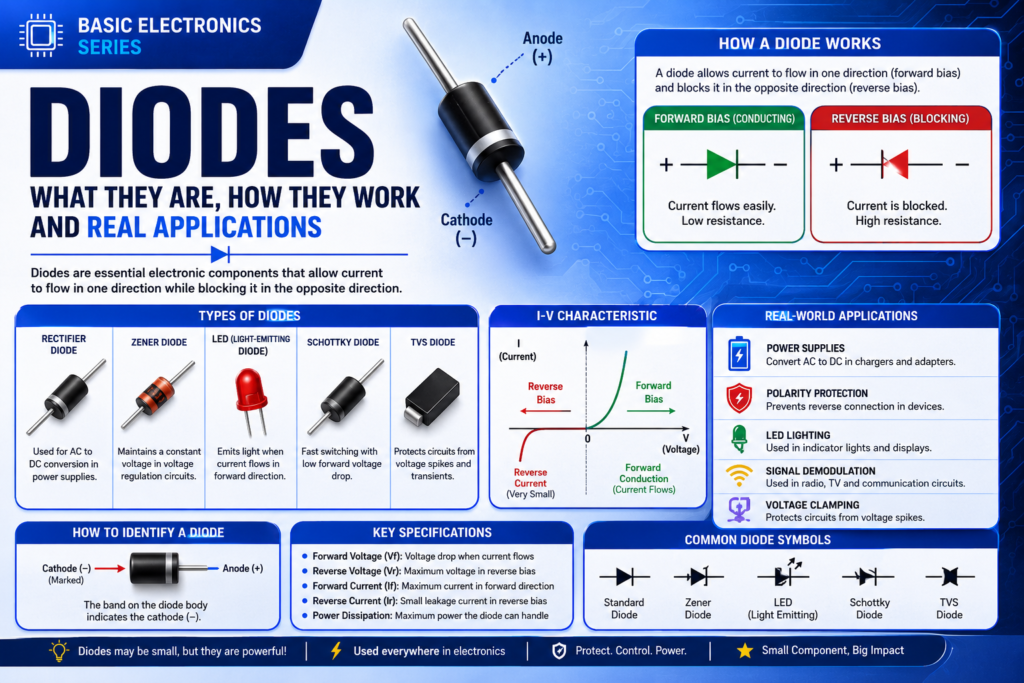
Table of Contents
Introduction
A diode is the simplest semiconductor component: it allows current to flow in one direction only and blocks it in the other. This simple behaviour is extraordinarily useful — diodes protect circuits from reversed polarity, convert AC to DC, clamp voltages, and of course produce light (LEDs). Understanding the p-n junction gives you the foundation for transistors, solar cells, and all semiconductor devices.
Before learning resistors, read:
• Voltage, Current and Resistance
Part 1: The P-N Junction
Silicon is a semiconductor — conductivity between a conductor and an insulator. Pure silicon has almost no free electrons, but doping it with impurities creates two types: N-type (doped with phosphorus, extra free electrons) and P-type (doped with boron, creating ‘holes’ that behave as positive charge carriers).
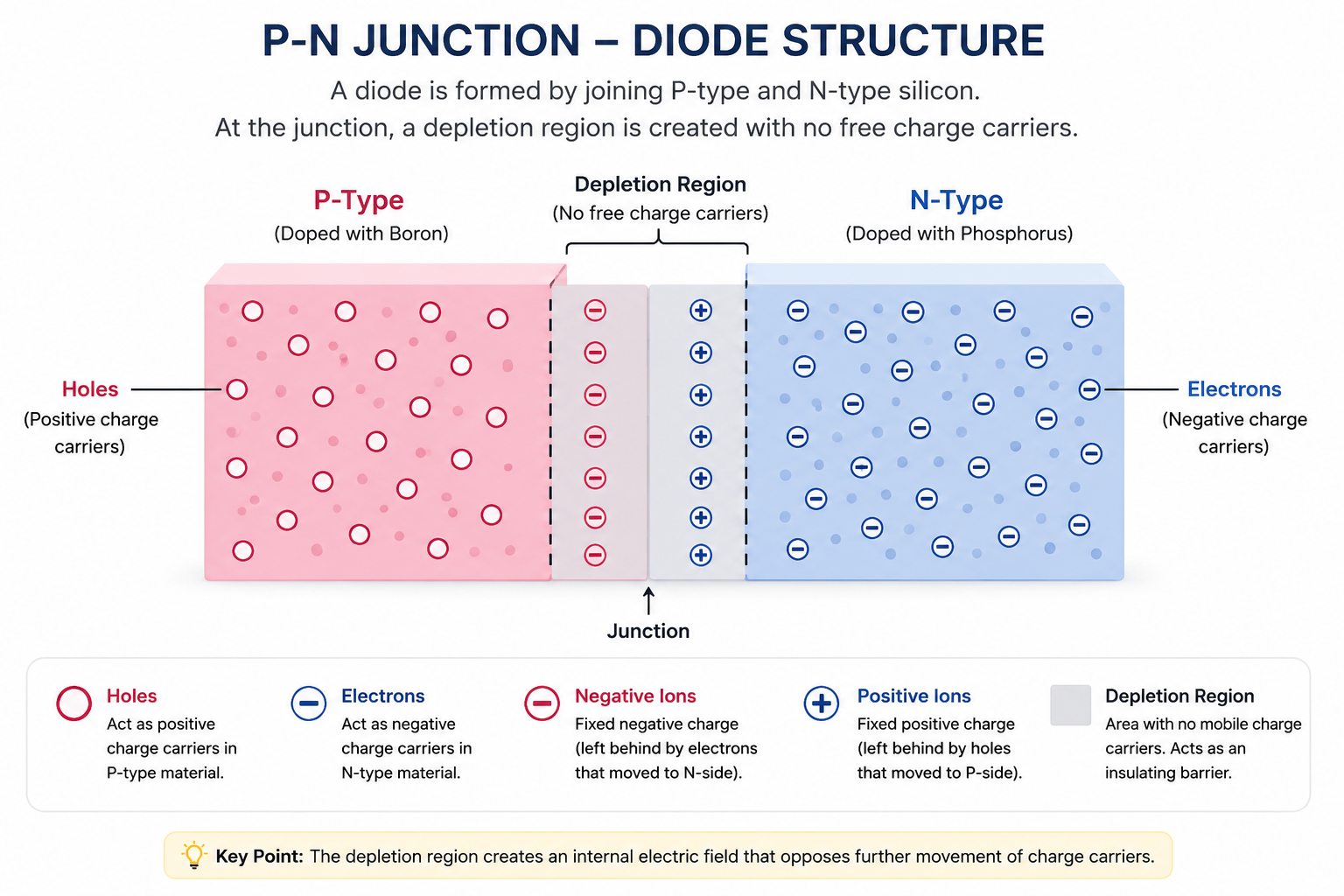
Figure 1 — A diode is formed by joining P-type and N-type silicon, creating a depletion region at the junction.
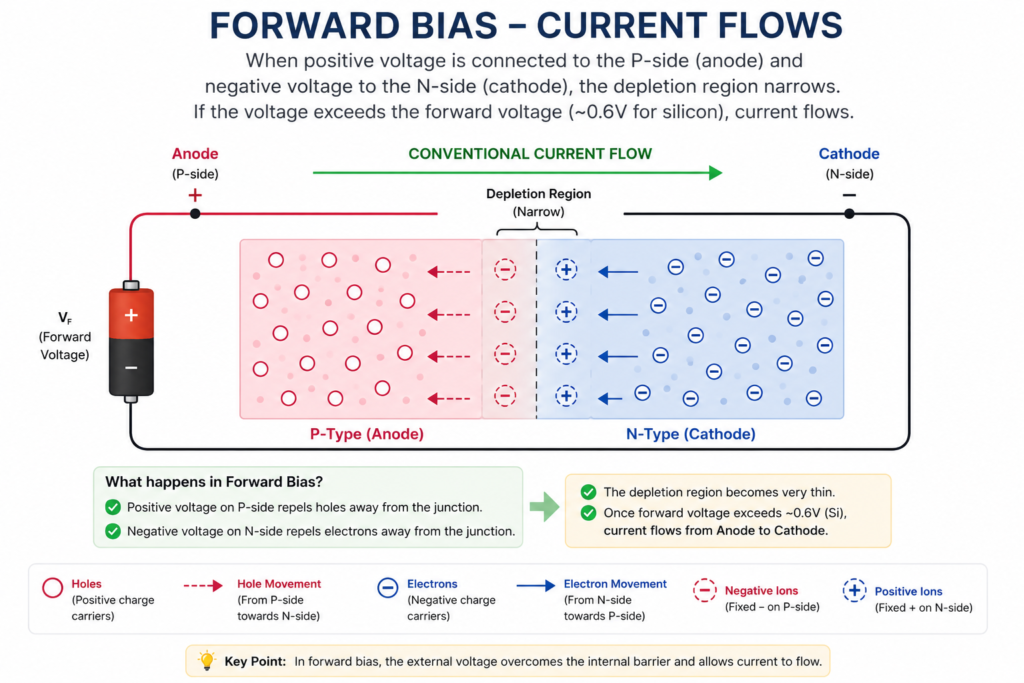
A diode is created by joining P-type and N-type silicon. At the junction, electrons from the N-side cross over and fill holes on the P-side, creating a ‘depletion region’ with no free charge carriers and an internal electric field.
Forward Bias — Current Flows
Connect the positive terminal to the P-side (anode) and negative to the N-side (cathode); the external voltage overcomes the internal field. Once voltage exceeds the forward voltage (~0.6V for silicon, ~2-3V for LEDs), the depletion region collapses and current flows freely.
Reverse Bias — Current Blocked
Connect it the other way and the external voltage reinforces the internal field, widening the depletion region. Almost no current flows (nanoamp-range leakage). If reverse voltage gets too high, the diode breaks down — permanently (damage) or intentionally (Zener diode, covered below).
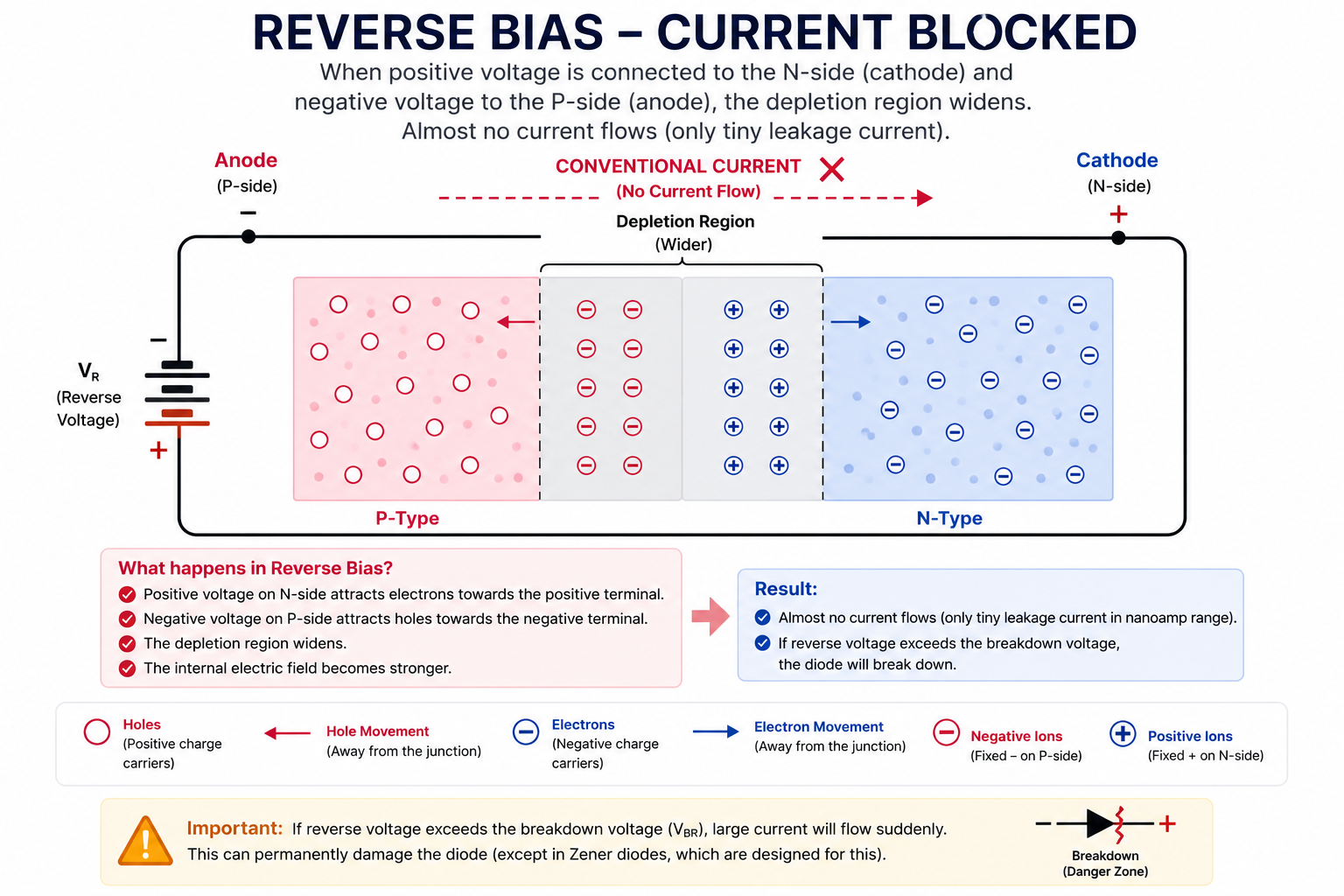
Figure 2 — Forward bias conducts; reverse bias blocks current (aside from tiny leakage).
🔑 KEY CONCEPT
ANODE (+): P-side, connects to positive. CATHODE (−): N-side, connects to negative.
The stripe on a diode body marks the CATHODE (like a minus sign).
Current flows: Anode → Cathode. Blocked: Cathode → Anode.
Part 2: Diode Characteristics
| Diode Parameter | Typical Value | Meaning |
| Forward voltage (Vf) | 0.6-0.7V (silicon) | Minimum voltage to start conducting |
| Maximum forward current | Up to 1A typical | Don’t exceed this or diode burns |
| Reverse breakdown voltage | 50-1000V | Max reverse voltage before breakdown |
| Reverse leakage current | Nanoamps | Tiny current that flows in reverse |
| Junction capacitance | pF range | Limits switching speed in RF circuits |
Part 3: Types of Diodes and Their Uses
1. Rectifier Diode (1N4007)
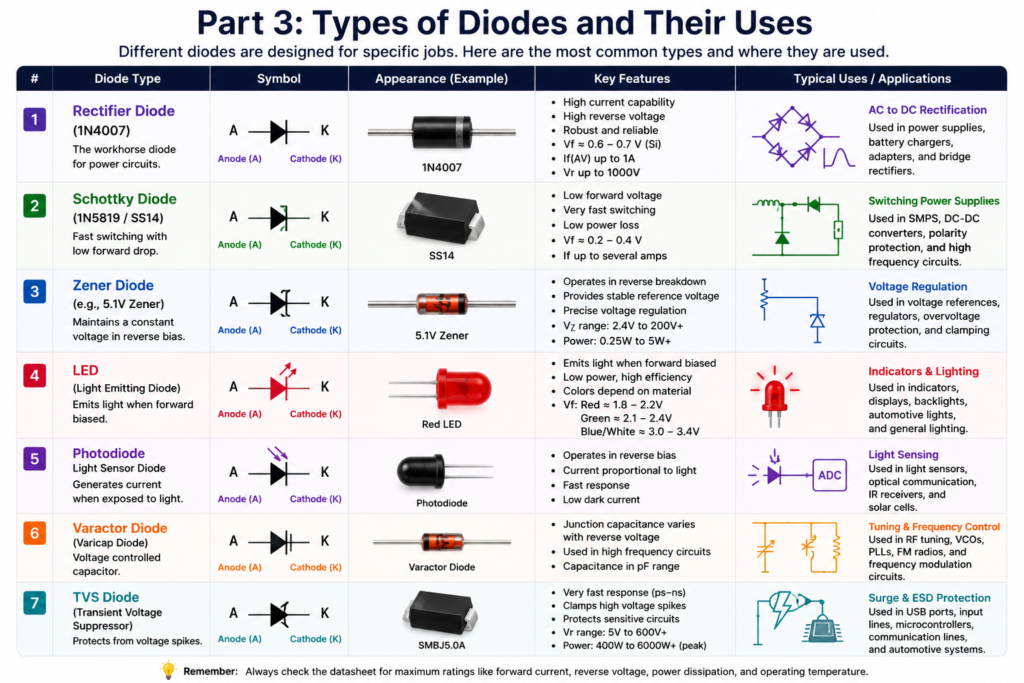
The workhorse diode used in power supplies to convert AC to DC. The 1N4007 handles 1A and 1000V reverse voltage. A bridge rectifier uses four diodes to convert both halves of AC.
2. Schottky Diode
Made with a metal-semiconductor junction instead of p-n. Lower forward voltage (0.2-0.4V vs 0.6V) and extremely fast switching. Used in switching power supplies and high-frequency circuits. Common: 1N5819, SS14.
3. Zener Diode
Designed to operate in reverse breakdown at a precise, stable voltage — perfect for voltage references and regulation. A 5.1V Zener keeps 5.1V across itself regardless of load (up to its power rating). Connects with cathode to the higher voltage point.
4. LED (Light Emitting Diode)
When current flows through certain semiconductor materials (GaAs, GaN, GaP), electrons recombine with holes and release energy as photons. Wavelength (colour) depends on the material. Forward voltage: red ~2V, green ~2.1V, blue/white ~3-3.4V.
5. Photodiode
Works in reverse: light falling on the junction generates a small current proportional to light intensity. Used in light sensors, optical communication, and solar cells.
6. Varactor Diode
Junction capacitance changes with reverse voltage — used as a voltage-controlled capacitor in radio tuning circuits and phase-locked loops (PLLs).
7. TVS Diode (Transient Voltage Suppressor)
Clamps voltage spikes in microseconds — much faster than a Zener. Used to protect circuits from ESD and voltage transients on input pins.
Part 4: Practical Applications
Reverse Polarity Protection
Put a diode in series with your positive power input. If someone connects the battery backwards, the diode blocks the reversed current and protects your circuit. Common for projects used by non-experts. Downside: you lose 0.6V. Use a Schottky (0.3V drop) to minimise loss.
Freewheeling / Flyback Diode for Motors
When a motor, relay, or solenoid switches off, the inductive load generates a voltage spike (sometimes hundreds of volts) that can destroy your transistor or MOSFET. A flyback diode connected in reverse across the motor clamps this spike — this is why every relay module has a diode on it.
⚠️ WARNING
Never drive a motor, relay, or solenoid from a transistor WITHOUT a flyback diode.
The voltage spike will destroy the transistor within a few switching cycles.
Connect a 1N4007 in reverse: anode to motor −, cathode to motor +, across the load.
✅ QUICK RECAP
A diode is a one-way valve: current flows from anode to cathode. The stripe = cathode.
P-N junction: forward bias overcomes internal field, current flows. Reverse blocks.
Forward voltage: silicon ~0.6V, Schottky ~0.3V, LED 1.8-3.4V depending on colour.
1N4007: general rectifier. Schottky: fast, low drop. Zener: voltage reference. TVS: protection.
LED emits light when current flows forward. Always use a current-limiting resistor.
Flyback diode: essential across any inductive load (motor, relay, solenoid).
Frequently Asked Questions
Q: What happens if I connect a diode backwards in a circuit?
A: In reverse bias, the diode blocks current (aside from tiny leakage), so the circuit simply won’t work as intended — for example an LED won’t light. This is generally safe as long as the reverse voltage stays below the diode’s breakdown rating.
Q: Why do LEDs have a much higher forward voltage than a regular silicon diode?
A: Forward voltage relates to the semiconductor’s bandgap energy — the energy needed for electrons to cross the junction and, for LEDs, emit a photon of a specific colour. Wider bandgap materials used for blue/white/UV LEDs require correspondingly higher forward voltages than the narrower bandgap in ordinary silicon diodes.
Q: Can I use a rectifier diode (1N4007) instead of a Schottky diode?
A: Often functionally yes, but you lose the Schottky’s advantages: a 1N4007 has a higher forward voltage drop (more wasted power) and switches much slower, which matters in high-frequency switching supplies but not in a simple low-speed reverse-polarity protection circuit.
Q: How do I know if a diode has failed, and how?
A: Use your multimeter’s diode test mode (Post 4). A healthy diode reads a normal forward voltage one way and OL (open) the other. A diode that reads OL both ways has failed open; one that reads near 0V both ways has failed shorted.
Q: Why does a flyback diode need to be rated for the full supply voltage and more?
A: The voltage spike from a collapsing magnetic field in a motor or relay coil can be many times higher than the supply voltage that was driving it. The flyback diode and the switching transistor both need enough voltage headroom to survive that spike safely.
Q: Is a Zener diode used the same way as a regular diode?
A: No — a regular diode is used forward-biased to conduct in one direction. A Zener is deliberately operated in reverse breakdown, where it holds a stable, known voltage across itself, making it useful as a voltage reference rather than as a simple rectifier.
🚀 NEXT UP
Post 8: LEDs — How to Connect One Without Burning It
We go deep on LEDs: types, current calculation, multiple LEDs, RGB control, PWM dimming, and addressable LED strips like WS2812B.