The two ways to connect components — and why it completely changes how they behave
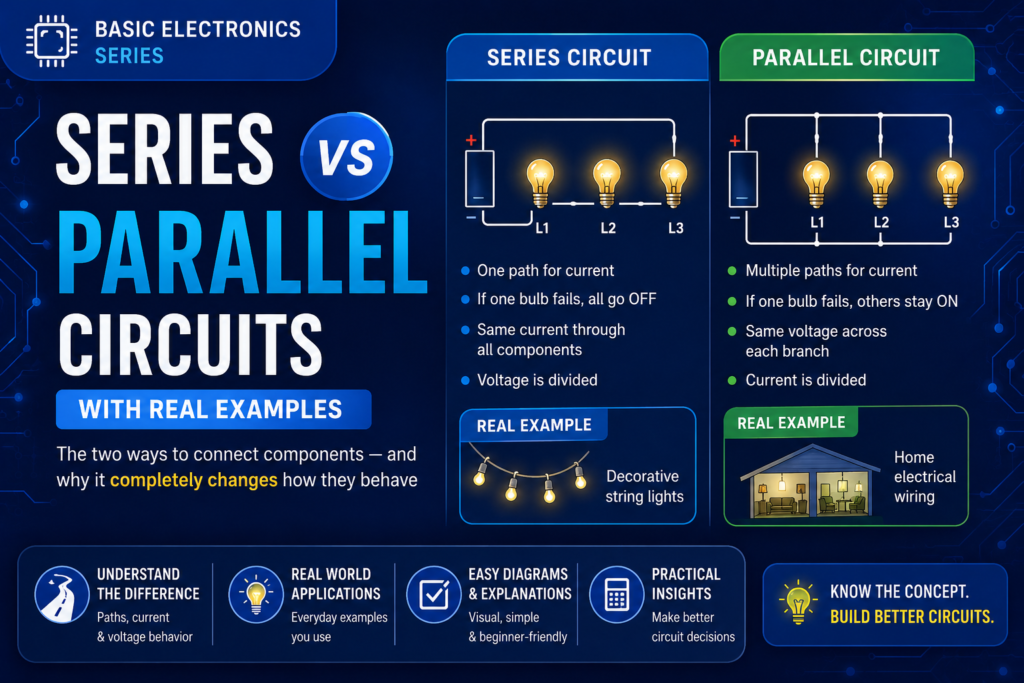
Table of Contents
Introduction
You have a 9V battery and three light bulbs. How do you connect them — series or parallel? The answer changes everything: the voltage each bulb gets, the current through each one, and what happens when one burns out. Every circuit you’ll ever build is made of series and parallel combinations, so recognising and analysing both is foundational.
Part 1: Series Circuits
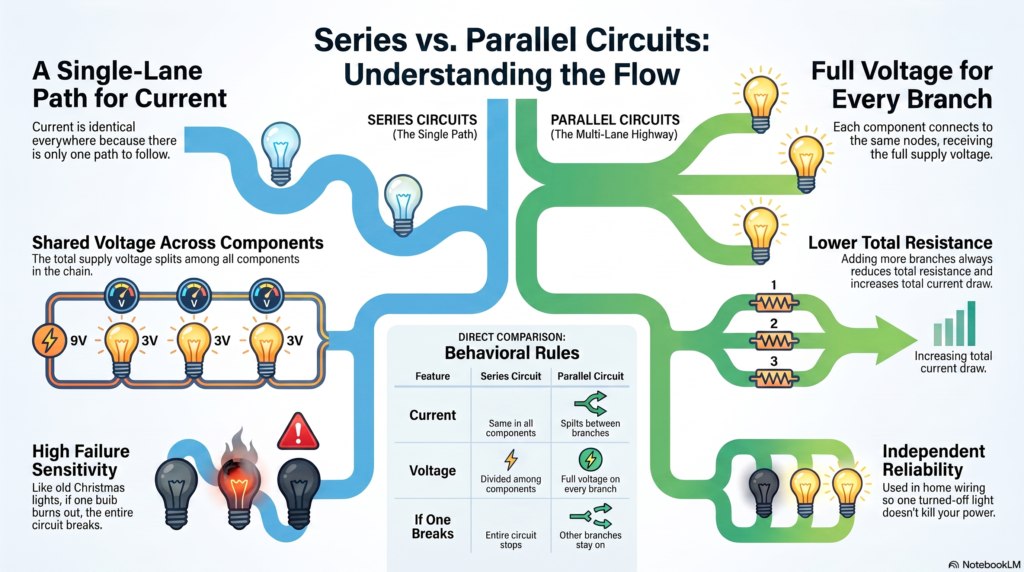
In a series circuit, components connect end-to-end in a single path — there is only ONE path for current to flow, and all components share the same current. Think of it like a single-lane road: every car must pass through every point.
| Property | Rule | Why |
| Current | Same through all components | Only one path — all current passes through each component |
| Voltage | Splits across components | KVL: drops must sum to supply voltage |
| Resistance | Total R = R1 + R2 + R3 + … | More components = more total opposition |
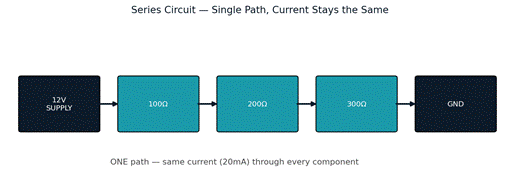
Figure 1 — A series circuit: a single path, current identical everywhere along it.
Series Example — Three Resistors
Circuit: 12V supply → 100Ω → 200Ω → 300Ω → GND.
1. Total resistance: R_total = 100 + 200 + 300 = 600Ω
2. Current (same everywhere): I = V ÷ R = 12 ÷ 600 = 0.02A = 20mA
3. Voltage across 100Ω: V = I × R = 0.02 × 100 = 2V
4. Voltage across 200Ω: V = I × R = 0.02 × 200 = 4V
5. Voltage across 300Ω: V = I × R = 0.02 × 300 = 6V
6. Check (KVL): 2 + 4 + 6 = 12V ✓
- Christmas fairy lights (old style): all bulbs in series — one burns out, all go dark.
- Battery cells in series: 1.5V + 1.5V + 1.5V = 4.5V (three AA batteries in a holder).
- Resistor + LED: the most common series circuit you’ll build in this series.
⚡ REAL WORLD
Old Christmas lights were wired in series — one bulb failing killed the whole string.
Modern LED Christmas lights are wired in parallel — one fails, the rest stay on.
This is a perfect real-world example of why parallel is often preferred for reliability.
Part 2: Parallel Circuits
In a parallel circuit, components connect side-by-side, sharing the same two nodes. There are MULTIPLE paths for current, and each path gets the full supply voltage. Think of a multi-lane motorway: traffic spreads across all lanes.
| Property | Rule | Why |
| Voltage | Same across all parallel components | Both ends of each branch connect to the same two nodes |
| Current | Splits between branches | KCL: total current = sum of branch currents |
| Resistance | 1/R_total = 1/R1 + 1/R2 + 1/R3 + … | More paths = less total resistance |
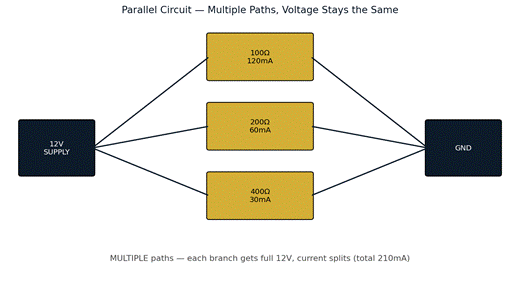
Figure 2 — A parallel circuit: multiple paths, full voltage on every branch, current splits between them.
Parallel Example — Three Resistors
Circuit: 12V supply with 100Ω, 200Ω, and 400Ω in parallel.
1. Voltage across each: all get full 12V (parallel rule)
2. Current through 100Ω: I = 12 ÷ 100 = 120mA
3. Current through 200Ω: I = 12 ÷ 200 = 60mA
4. Current through 400Ω: I = 12 ÷ 400 = 30mA
5. Total current from supply: 120 + 60 + 30 = 210mA
6. Total resistance: R = 12 ÷ 0.210 = 57.1Ω (less than the smallest branch — always true in parallel!)
🔑 KEY CONCEPT
In parallel circuits, total resistance is ALWAYS less than the smallest individual resistor.
Adding more parallel branches always REDUCES total resistance and INCREASES total current drawn from the supply.
Special case: two identical resistors in parallel always give half the resistance of one — two 100Ω resistors in parallel = 50Ω. General formula for two resistors: R_total = (R1 × R2) ÷ (R1 + R2).
- Your home electrical wiring: every socket is in parallel, each device gets full 230V.
- Multiple LEDs on the same Arduino pin: connect in parallel so each gets full voltage.
- USB hub: each port gets full 5V regardless of how many devices are connected (within current limits).
- Battery cells in parallel: same voltage, but higher total current capacity.
Part 3: Series-Parallel Combinations
Real circuits mix series and parallel components. Simplify step by step: combine parallel groups into a single equivalent resistor, then handle any remaining series components (or vice versa).
Example: 9V supply. R1 = 100Ω in series with a parallel combination of R2 = 200Ω and R3 = 200Ω.
1. Simplify parallel section: R2 ∥ R3 = (200 × 200) ÷ (200 + 200) = 100Ω
2. Circuit becomes: 100Ω (R1) in series with 100Ω (R2∥R3) = 200Ω total
3. Total current: I = 9 ÷ 200 = 45mA
4. Voltage across R1 (series): V = 0.045 × 100 = 4.5V
5. Voltage across parallel section: V = 9 − 4.5 = 4.5V
6. Current through each parallel resistor: I = 4.5 ÷ 200 = 22.5mA each (= 45mA total ✓)
🛠️ TRY IT
Build this on a breadboard: 9V battery → 330Ω → two 1kΩ resistors in parallel → GND.
Measure voltage across the parallel section and current before the split.
Measure current in each parallel branch — verify branch currents add up to total (KCL) and voltage drops sum to 9V (KVL).
Part 4: Comparing the Two — Quick Reference
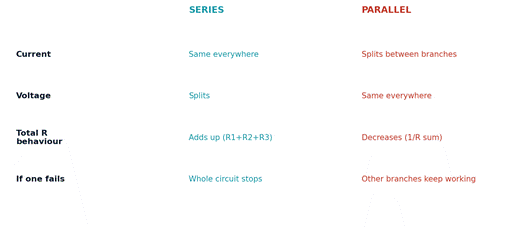
Figure 3 — Series vs parallel behaviour at a glance.
| Series | Parallel | |
| Current | Same in all components | Different in each branch |
| Voltage | Splits across components | Same across all branches |
| Total Resistance | Sum of all (R increases) | Inverse sum (R decreases) |
| If one breaks | Whole circuit stops | Other branches still work |
| Battery drain | Lower current draw | Higher current draw |
| Examples | Resistor chains, LED + resistor | Home wiring, USB hub, LED arrays |
✅ QUICK RECAP
Series: one path, same current everywhere, voltage splits. R_total = R1 + R2 + R3.
Parallel: multiple paths, same voltage everywhere, current splits. 1/R = 1/R1 + 1/R2.
In parallel, total resistance is ALWAYS less than the smallest individual resistor.
Use KVL (voltage drops sum to supply) to verify series calculations.
Use KCL (branch currents sum to total) to verify parallel calculations.
Real circuits are combinations — simplify parallel groups first, then handle series.
Frequently Asked Questions
Q: How do I quickly tell if a circuit is series or parallel just by looking at it?
A: Trace the current path. If there’s exactly one path from + to − through every component, it’s series. If the path splits into two or more branches that reconnect later, it’s parallel.
Q: Why does adding more parallel branches draw more total current from the battery?
A: Each branch offers an independent path with its own resistance, and the total resistance seen by the source decreases as branches are added. With supply voltage fixed, lower total resistance means higher total current (I = V/R).
Q: Is it true that a short circuit is just an extreme case of parallel resistance?
A: In a sense — a short is a near-zero-resistance path placed in parallel with your circuit. Since parallel resistance is always less than the smallest branch, an accidental zero-ohm branch pulls the total resistance toward zero, causing a current surge.
Q: Why do old Christmas lights go fully dark when one bulb fails, but modern strings don’t?
A: Old strings wire bulbs in series, so one broken filament breaks the only current path for the entire string. Modern LED strings wire sections in parallel, so a failure in one branch doesn’t interrupt the others.
Q: Can a circuit be neither purely series nor purely parallel?
A: Yes — most real circuits are series-parallel combinations. The technique is to identify and collapse the purely parallel or purely series sub-sections first, working inward until you have one equivalent resistance.
Q: Do LEDs in series need less total power than the same LEDs in parallel?
A: Yes, typically. Series LEDs share a single resistor and current path, so overall resistor power loss is lower per LED. The trade-off is that if one LED fails open, the whole string goes dark — as covered in Post 8.
🚀 NEXT UP
Post 4: How to Use a Multimeter — Every Function Explained Now that you understand circuits theoretically, we pick up the