The three fundamentals every electronics engineer must understand before touching a circuit
Introduction
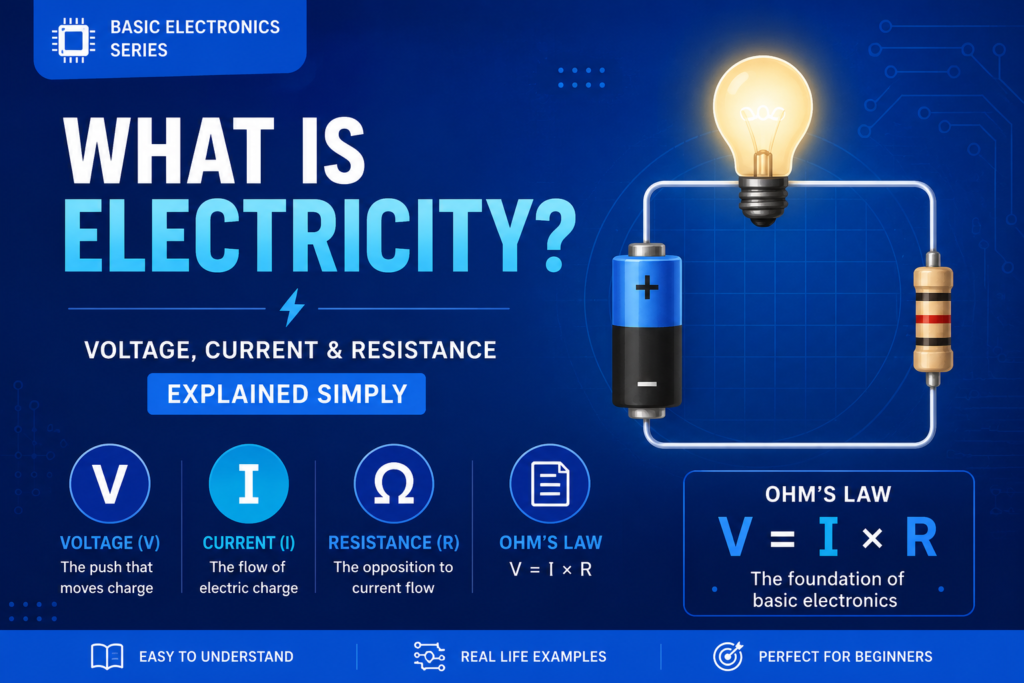
You’ve used electricity your whole life — charging your phone, switching on lights, listening to music. But what actually IS electricity? What is flowing through those wires, and why does your phone charger output 5V and not 10V or 100V? These aren’t academic questions. Every electronics project, from a single LED to an industrial motor controller, is built on three fundamentals: Voltage, Current, and Resistance.
This post goes deep on all three from first principles, building the mental model you’ll rely on for the rest of this series — and adds visual diagrams so the abstract becomes concrete.
📝 NOTE
No maths required for this post — just concepts. The maths arrives in Post 2 with Ohm’s Law.
Read this post fully, even if you think you already know what voltage is.
Table of Contents
Part 1: What is Electricity, Really?
The Atom — Where It All Starts
Everything physical is made of atoms: a nucleus of protons (positive) and neutrons (neutral), orbited by electrons (negative). In insulators (rubber, plastic, glass, wood) electrons are tightly bound and cannot move. In conductors — copper, aluminium, gold — the outermost electrons are loosely bound and drift freely between atoms. That looseness is precisely what makes metals useful for wires.
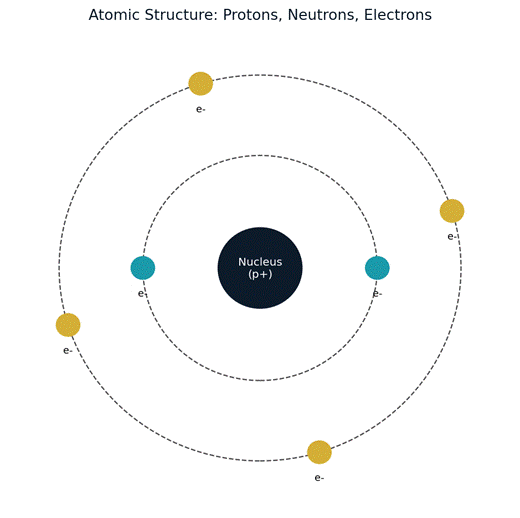
Figure 1 — Nucleus with orbiting electrons. Only the outermost (loosely bound) electrons are free to drift in a conductor.
🔑 KEY CONCEPT
ELECTRICITY is simply the controlled movement of free electrons through a conductor.
When billions of electrons drift in the same direction through copper, that flow of charge is what we call current.
The Water Analogy
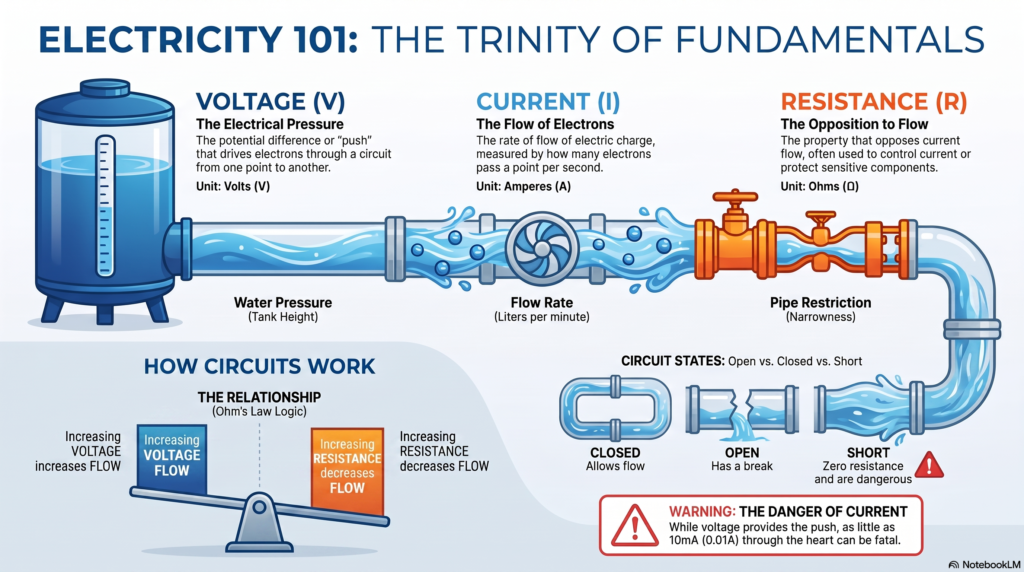
The single most useful mental model for electricity is the water-pipe analogy. It isn’t perfect, but it gets you 90% of the way instantly: an elevated tank creates pressure (voltage); a pipe lets water flow (current); a narrow restriction in the pipe resists that flow (resistance).
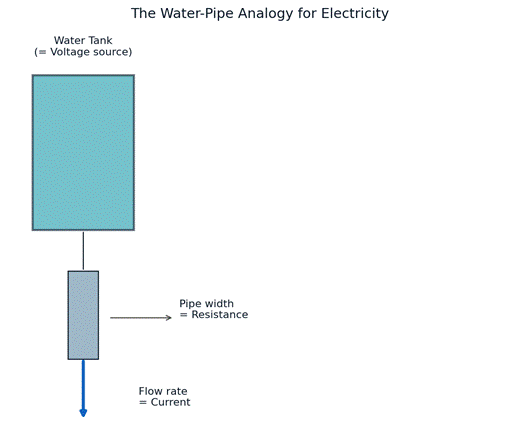
Figure 2 — Tank height = voltage, pipe restriction = resistance, flow rate = current.
| Electrical Concept | Water Analogy | Unit |
| Voltage (V) | Water pressure in the pipe | Volts (V) |
| Current (I) | Flow rate of water (litres/min) | Amperes / Amps (A) |
| Resistance (R) | Pipe width restriction | Ohms (Ω) |
| Power (P) | How much work the water does | Watts (W) |
| Charge (Q) | Volume of water | Coulombs (C) |
The critical insight: increase pressure (voltage) and more water flows (current increases, if resistance stays fixed). Add restriction (resistance) and less flows. This exact relationship is Ohm’s Law, covered fully in Post 2.
Part 2: Voltage — The Electrical Pressure
Voltage is the potential difference between two points — the ‘push’ that drives electrons through a circuit. Voltage does NOT flow; it exists as a difference between two points. You never say ‘the voltage at point A’ — you say ‘the voltage from point A to point B.’ That’s why a multimeter always uses two probes.
| Voltage | Source | What it Powers |
| 1.5V | AA/AAA battery | Small toys, remote controls |
| 3.3V | Modern MCU logic level | ESP32, nRF52, Raspberry Pi GPIO |
| 5V | USB port, Arduino | Arduino Uno, most sensors, basic circuits |
| 9V | PP3 battery, some adapters | Arduino barrel jack input |
| 12V | Car battery, PSU | Relays, solenoids, some motors |
| 230V | Indian mains power | Everything plugged into the wall |
| 415V | Three-phase industrial | Heavy motors, industrial equipment |
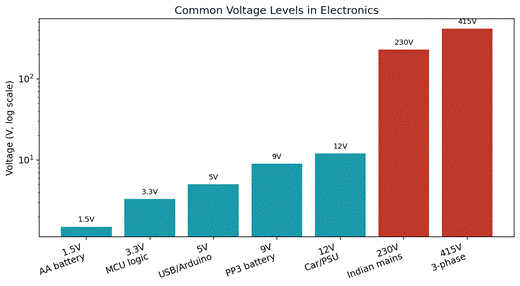
Figure 3 — Common voltage levels shown on a logarithmic scale. Notice how mains voltage dwarfs microcontroller logic levels.
⚠️ WARNING
230V mains voltage is LETHAL. Never touch mains wiring without proper training.
A current of just 10 milliamps (0.01A) through the heart can be fatal.
All projects in this series use 3.3V or 5V — completely safe to handle.
DC vs AC Voltage
- DC (Direct Current): constant voltage, fixed direction. Batteries, USB, Arduino power pins. Your circuits will almost always use DC.
- AC (Alternating Current): voltage alternates direction 50 times per second (50Hz in India) — this is mains electricity, more efficient to transmit over long distances.
⚡ REAL WORLD
Your phone charger converts 230V AC from the wall into 5V DC for charging.
Inside is a switching power supply (SMPS) that performs this conversion.
We’ll cover power supplies in depth in Post 12.
Part 3: Current — The Flow of Electrons
Current is the rate of flow of electric charge, measured in Amperes (A). One Ampere = one Coulomb of charge flowing past a point every second — and one Coulomb is roughly 6.24 × 10¹⁸ electrons. Even a modest 1A current involves an almost incomprehensible number of electrons moving every second.
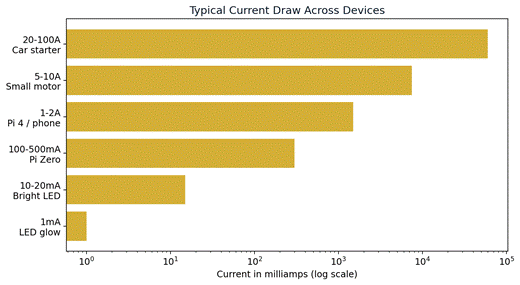
Figure 4 — Typical current draw across common devices, log scale (milliamps).
| Current | What it does |
| 1 mA (0.001A) | Barely visible LED glow, some sensor signals |
| 10-20 mA | Bright LED at full brightness |
| 100-500 mA | Raspberry Pi Zero, small Arduino projects |
| 1-2 A | Raspberry Pi 4, smartphone charging |
| 5-10 A | Small motors, 3D printer heated bed |
| 20-100 A | Car starter motor, EV charging |
| 10,000+ A | Lightning bolt (for reference!) |
Conventional vs Electron Current
Historically, scientists assumed current flowed positive-to-negative (conventional current). Later we discovered electrons actually flow negative-to-positive — the opposite direction. In electronics we still use conventional current direction in every diagram and calculation. The maths works either way, so this quirk doesn’t affect practice — just be aware it exists.
Part 4: Resistance — The Opposition to Flow
Resistance opposes the flow of current, measured in Ohms (Ω). Every material, component, and wire has some resistance. A resistor converts electrical energy into heat — sounds wasteful, but this is incredibly useful: it lets us control current, protect components, and build voltage dividers.
What Determines Resistance?
- Material: copper has very low resistance (good conductor); nichrome wire has high resistance (used in heaters).
- Length: longer wire = more resistance (electrons travel further).
- Cross-section: thicker wire = less resistance (more paths for electrons).
- Temperature: most metals increase resistance as they heat up.
⚡ REAL WORLD
The tungsten filament in an incandescent bulb has very high resistance.
Current flowing through it heats it to ~2700°C — hot enough to glow.
This is resistance deliberately used to produce light and heat.
| Type | Resistance | Examples | Use in Electronics |
| Conductor | Very low (<1Ω/m) | Copper, aluminium, gold | Wires, PCB traces, connectors |
| Semiconductor | Variable (controlled) | Silicon, germanium | Transistors, diodes, ICs, solar cells |
| Insulator | Extremely high | Rubber, plastic, glass | Wire coating, PCB substrate, enclosures |
🔑 KEY CONCEPT
Semiconductors are the foundation of all modern electronics.
Their resistance can be controlled by applying voltage or current — this is how transistors work, the building block of every computer chip.
Part 5: How They Work Together
- More voltage (more pressure) → more current flows (if resistance is fixed)
- More resistance → less current flows (if voltage is fixed)
- Keep voltage the same and want less current → increase resistance
- Keep resistance the same and want more current → increase voltage
A Practical Example: LED Circuit
An LED is damaged if too much current flows through it. A typical red LED wants ~20mA and has a forward voltage of 2V. Connect it directly to a 5V Arduino pin and it tries to draw unlimited current, burning out instantly. Adding a resistor limits the current to a safe level: R = (5 − 2) ÷ 0.02 = 150Ω. The nearest standard value, 220Ω, is used to stay safely under that limit.
🛠️ TRY IT
Get an Arduino Uno (or any 5V source), a red LED, and a 220Ω resistor.
Connect: 5V pin → 220Ω resistor → LED anode (long leg) → LED cathode (short leg) → GND.
The LED lights up. Try a 1kΩ resistor — it’s dimmer. Now try NO resistor for 0.5 seconds — it burns out. This demonstrates exactly how resistance controls current.
Part 6: Open, Short, and Closed Circuits
| Circuit Type | Description | Result |
| Closed | Complete path from source, through components, back to source | Electrons flow, circuit works |
| Open | A break in the path (disconnected wire, blown fuse, off switch) | Current = 0, nothing happens |
| Short | Direct connection between + and − with near-zero resistance | Huge current, extreme heat, possible fire |
⚠️ WARNING
Never connect the positive and negative terminals of a battery or power supply directly.
Always have components (resistance) in the circuit to limit current.
Even a AA battery can get dangerously hot if short-circuited with a wire.
✅ QUICK RECAP
Electricity is the controlled flow of electrons through a conductor.
Voltage (V) is the electrical pressure — measured in Volts.
Current (I) is the rate of electron flow — measured in Amperes.
Resistance (R) opposes current flow — measured in Ohms.
More voltage = more current. More resistance = less current.
Closed circuit = current flows. Open = no flow. Short = too much flow.
DC is constant (batteries, USB). AC alternates (mains power).
Frequently Asked Questions
Q: Is voltage the same thing as current?
A: No. Voltage is the pressure that pushes electrons; current is the actual rate of electron flow that results. You can have high voltage with almost no current (a static shock) or low voltage with high current (a car battery cranking a starter motor).
Q: Why does my phone charger say 5V but my wall socket is 230V?
A: The charger contains a switching power supply that converts the higher AC mains voltage down to a safe, steady 5V DC suitable for charging electronics. We cover exactly how in Post 12.
Q: Can current flow without voltage?
A: No. Current only flows when there is a voltage difference (a potential difference) across a conductor. Zero voltage difference means zero current, regardless of how good a conductor the wire is.
Q: Is a higher resistance always safer?
A: Generally yes for limiting current to protect components like LEDs, but too much resistance can also starve a circuit of the current it needs to function. The goal is the right resistance for the job, not simply the highest one.
Q: Why is 10mA through the heart dangerous but LEDs run at 20mA safely?
A: Current path matters enormously. An LED’s 20mA flows through a tiny semiconductor junction designed for it. The same current through the human heart — a path it was never designed for — can disrupt its electrical rhythm. Voltage level and skin resistance also change how much current actually enters the body.
Q: What’s the difference between a conductor and a semiconductor?
A: A conductor like copper always conducts well. A semiconductor like silicon can be made to conduct or block current depending on how it’s doped and what voltage is applied — this controllability is what makes transistors and diodes possible.
🚀 NEXT UP
Post 2: Ohm’s Law — The One Formula Every Engineer Must Know
We take the concepts from this post and apply the maths — calculating resistor values, predicting current, and understanding why Ohm’s Law underpins every project.